Thursday, March 10, 2011

CITY OF SIGNS: "What the Hell?" Edition

I've obscured the phone number on the theory that it belongs to someone
who doesn't really want untalented girls calling them.  Hm...  Maybe I
should put up some posters...
Snapped this picture tonight on the way home from work.  It's on one of those big poles that get put up exclusively for the purpose of having posters all over them.

My theory is that someone got dropped from a band to make room for new members, and those members were perhaps female.  Possibly the remaining original member wanted to sleep with one of them.  Terms like, "betrayal," "sell out," "that's my amp," etc, may have been thrown around.

I do like to imagine, though, that somewhere, somebody's living room is full of more-or-less identical bleach-blonde twenty-somethings, each with a guitar their parents just bought for them, sitting around making awkward small-talk while they wait for their turn to audition.  The Sonic Youth song they're being asked to lip sync to filters in from the garage.

Also fun: The coffin-shaped "FATALITY" signs the city apparently puts up at the sites of deadly car accidents.  I understand the premise, but when they genuinely look exactly like the coffin a cartoon vampire would come out of, it sort of undermines it.

Tuesday, March 08, 2011

Feedback on Sarcastic Doorman

I took some of my homebrew, the last of the Sarcastic Doorman, to the Homebrewers' Guild meeting last night, and passed it around.  Feedback was actually very positive!  Some of the more experienced hands advised that I should be toning down the rye a bit - I can see what they mean.  After getting quite a bit of advice I'm going to try a batch with half the rye to give myself another reference point, and go from there.

I'm also going to recreate the recipe with light extract rather than dark.  The trouble with dark extract, of course, is that you have no control over the grain bill - it's made from whatever combination of grains the maltster thought was desirable and even if it's the colour you want it may not give you the properties you're looking for.  By going with a very pale extract, you know better what you're getting (pale base malt), and that way all the specialty grains are your own.

I've got a lot on my to-do list after last night, actually, but one thing at a time.

The label got VERY good reviews, though.

Saturday, March 05, 2011

BOTTLING: Buckwheat Cuivrée

My fellow brewer, Mr. Smashton, dropped by on Wednesday evening and we bottled this batch in real glass! I've only got around to posting about it now, though.

My first challenge was collecting enough bottles. Here in Alberta you have to take your empties to a designated Bottle Depot, rather than just anyplace that sells beer, so I have plenty of bottles around the apartment, but I didn't want to try screw-tops my first time out. After a thorough search I put together a motley selection of fifteen bottles that were appropriate.


I had to soak them overnight to remove (most) of the labels (the label on the bottle of Japanese Imperial Smoked Porter proved too tenacious for the chemicals I have at my disposal). I sanitized them all, as well as my caps, Mr. Smashton's capper, the siphon, bucket, and all other equipment with iodophor.

Next, we weighed out the priming sugar which will feed the remaining yeast so they can produce CO2 and carbonate the bottled beer. I used approximately fifty grams of corn sugar, which given the amount and temperature of the beer should yield slightly higher than normal carbonation, around three volumes of CO2 (a typical American beer is two to two and a half). We dissolved the sugar in a little boiling water, cooled it, and the gently racked the beer from the secondary into the bottling bucket so as to mix it with the sugar thoroughly without introducing too much oxygen. We took a small sample during racking to recheck the gravity, which is unchanged since last time at 1.020.

~ 50 grams of corn sugar
Sadly it was no longer that shade
of orange soda when we finished.
We siphoned everything into the bottles one at a time.  Even though having Mr. Smashton there to help made this much, much easier, it's still kind of a messy, involved pain (which is why there are no pictures of this part), especially to get started.  I have a ball valve spliced into my siphon line so I can start and stop it, and this is very handy, but I'm going to have to put together a better bottling system, especially as I won't always have Mr. Smashton to help me.  I lost at least a full bottle to siphon mishaps this time, in addition to the usual amounts left behind when racking and so on.

In any event, once we got through that, it was time to cap the bottles!

A bowl of sanitized crown caps and a wing capper,
provided by Mr. Smashton.
The procedure was pretty simple.  First, place crown caps loosely on all the bottles, then, work your way down the line with the wing capper crimping each cap on.  The trick, as it turned out, was removing the bottles from the capper - once again, having two people was essential.

The loose cap.
Crimping the cap takes little force.

I'm using my other hand to take the
picture.  I needed both to actually
get the capper off the bottle.
The end result!
Finally, we lined all the bottles up in a cardboard box lined with a trash bag and some newspaper (I understand that so-called "bottle bombs" are actually very rare, but to read a homebrewing newsgroup you'd think they were the leading cause of death), and stowed them away to carbonate. Probably one to two weeks and a bit in the fridge, and they'll be ready to drink. And drink them I shall, if only to get rid of the things... We tried a little that didn't make it into bottles (you'll notice there aren't actually fifteen bellow), and it's... Well, the hops didn't make it much more exciting.


Saturday, February 19, 2011

RACK: Buckwheat... Cuivrée?

Well, it's certainly not an amber anyway.

I transfered my buckwheat beer to a secondary fermenter tonight, after what seemed like hours of very, very thorough cleaning and sanitizing and rinsing (with small batches like this, I don't think there's any such thing as a no-rinse sanitizer, even a tiny bit of iodine will affect the end product). It's going to need some time to clear, certainly, but I'd say it was fully fermented; it had dropped to the specific gravity I expected (1.025 - taking into account I thought my original gravity was going to be 1.04ish and it turned out to be 1.065), and wasn't showing any signs of activity. It's probably going to end up cloudy anyway, but it'll get better than it is now.

Unless my Tap-a-Draft bottles are bigger than advertised (that's what I'm using as a secondary, my small-batch airlock fits it), I've got about five and a half liters of beer there, so that's not too bad in terms of racking losses and so on. Procedure-wise this has been pretty successful.

I tasted the hydrometer sample, and it's not bad... I knew it wasn't likely but was hoping in my heart for something akin to Coup de Grisou, a buckwheat beer I enjoyed in Montréal, but what I'm ending up with is, I would say... Well, it's beer. It tastes kind of beery. It'll probably go fast enough, but I'm probably going to chalk this one up to experience. I think buckwheat, even unmalted, requires a mash, next time, and it has to be a much larger percentage of the grain bill. In an effort to make this one more interesting, I've thrown four grams of Amarillo pellets into the secondary to dry-hop it; we'll see how that works out.

Sunday, February 13, 2011

BREW DAY: Buckwheat Amber?

Not much to it, really.

Sanitation is very important.


This was a fairly simple beer, just some extra-light DME, a little crystal malt, the buckwheat I roasted yesterday, Amarillo hops left from my porter and a packet of dry yeast.  The day was never-the-less not without its complications, which started when I realized I didn't have any cheese cloth to strain the water from my steeping grains and had to go out to buy some on the sheets of ice Edmonton is currently experimenting with as replacement sidewalks.  Fortunately, I've been trained to fall without getting hurt.

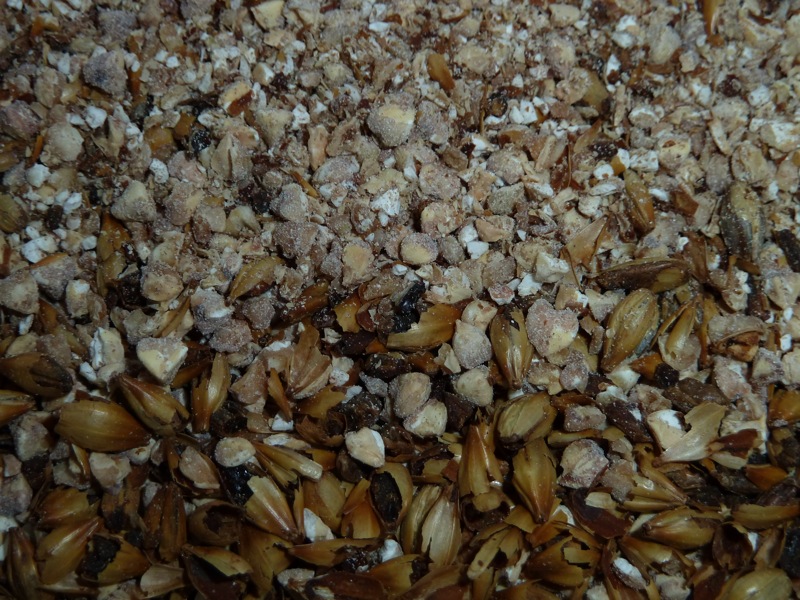
First off, I needed to crush my steeping grains, the buckwheat I roasted yesterday (which weighs in at a little less after the roasting) and 50g of extra-dark crystal malt.


Although I'm making a larger batch than last time, you can see I'm steeping a lot less grains, since I'm trying for a lighter colour:


The colour I got from this steep wasn't as red as I would have liked - you'll see at the end it's more of a cuivrée than an amber - but I think that's down to my choice of grains.  Oh, well.  The steeping water is slightly cooler to start with this time, and I wrapped a towel around the cooler in the hopes that I would have a more consistent temperature over time.  It seemed to work.


Estimating that I got about four liters back from my ~4.5 liter steep (I probably got less, the buckwheat took up a lot) and that I would get something like one liter of boil-off in sixty minutes (based on my last batch), I topped up with about a liter and a half (okay, actually that number was as arbitrary as these parentheticals are becoming) for the boil and added my bittering hops.


I only used three grams, since this is meant to be a light
"session" beer.

I boiled for about 45 minutes before adding the extract; for some reason I wanted to add it before the aroma hops, which went in with ten minutes left (out of 60 minutes total boiling time).


Three grams this time as well.

Finally, while my wort was chilling in the sink like last time, I rehydrated my yeast.  Package directions call for rehydrating in water between 80-92 degrees Fahrenheit, and then adding a little wort at a time to bring the yeast gradually down to the wort's temperature (about 72 degrees).


Once again I underestimated my boil-off and/or over-estimated the yield from my steep; I was more than a liter short of where I expected to be.  I decided to top it right up to six liters - it's meant to be a session beer anyway, only three or four percent alcohol.


My original gravity (OG) reading doesn't line up with that at all, though!  It's something like 1.065, and temperature correction doesn't make much difference...  According to every brewing calculation I can find, this is way off, and my OG shouldn't be much over 1.040.  I'm guessing it's starches from the buckwheat, mostly, which is probably going to mean cloudy beer but isn't going to increase my ABV at all - it should still come out around 4%, maybe 4.5% if the yeast really goes to town (I've heard Nottingham gives high attenuations).


All's well that ends well, of course so...  In about a month, when this is ready, I'll let you know if it's well.  There's still one last complication with this batch, too...  I've decided it will be my first in glass bottles.  We'll see how that works out!

Saturday, February 12, 2011

ROASTING GRAIN: Buckwheat Amber

I'm making a little batch of amber (hopefully) ale this weekend, about five liters, no clever name or labels at the moment. The only particularly noteworthy aspect is that I'm going to use up some buckwheat groats I had about in it, and I decided to home roast them a little bit.  This is the first time I've tried either of these things.


I started with about 158.8 grams of buckwheat (it's a 75 gram measuring cup).

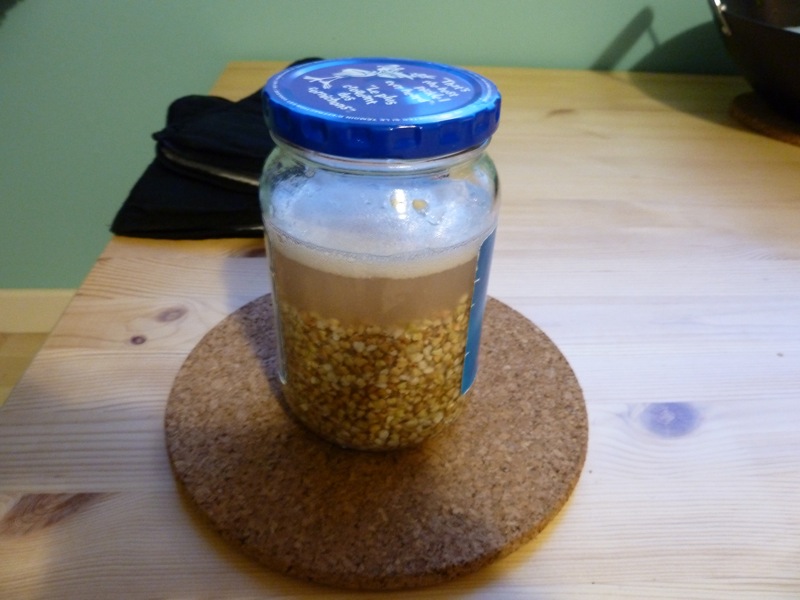
While the oven preheated to 120 degrees Celsius, I soaked the groats briefly in cold water, shaking frequently:


I decided to rinse them because I currently only steep my grains rather than doing a proper mash.  If I were mashing with a base grain (some pale malt, say), there would be enzymes converting starches into sugars the yeast can eat, but no such process takes place in a steep, so washing a bit of excess starch off (a great deal, actually, after a few minutes the water you soak buckwheat in has turned to sludge) will help my beer's clarity and flavour.  It's also possible that steam from the water left on the grains while I roasted them would at least partly gelatinize the starches inside the groats, but I'm not really getting my hopes about that.

Finally, I put the grains in the oven for about an hour, turning them every fifteen minutes or so and increasing the temperature to 300C about halfway through.  The end result wasn't a terribly dark roast, but it has a nice nutty flavour I'm hoping will come through and should do me fine when I brew tomorrow.  Fingers crossed!


Saturday, February 05, 2011

Don't Cook This At Home

You may recall that I posted a two-part pilot episode for a "cooking show" called Don't Cook This At Home on this blog some time ago.  I mentioned in that new episodes would appear "highly irregular[ly]" and I meant it - we're still working on the second one.  It's tricky to achieve just the right balance between something wildly impractical and something we can actually do.

In the meanwhile, though, I've finally gotten around to cutting that first episode, nearly thirty minutes in two parts, down to something more appropriate for the Internet Age attention span, a mere seven minutes and twenty-one seconds.

And here it is:


Yep.